Rotation on-time %: the defensive metric that tells you the truth
Rotation on-time %: the defensive metric that tells you the truth
Most teams talk about “help defense.” Very few can tell you if their help actually arrives in time to change the possession.
That is what Rotation on-time % does. It strips away excuses, effort talk, and “we were there.” It asks one hard question:
When you help, how often does that help arrive inside the window where it still matters?
If your rotations are late, your scheme will always look worse than it is. If your rotations are on time, you can guard above your talent level.
This post breaks down what Rotation on-time % is, how to define “on time” in real situations, how to tag it in film, and how to train it on the floor.
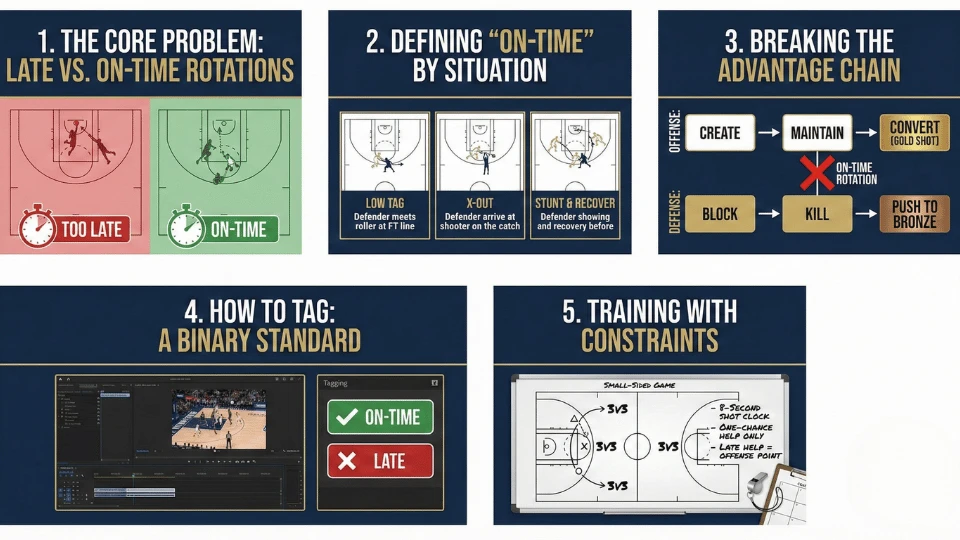
What is Rotation on-time %?
Definition: Rotation on-time % = on-time helps / total helps
You judge every help as either:
– On-time
– Late
There is no “almost.” No “pretty good.” No middle category.
If the rotation arrives within the small window where it actually changes the shot or pass, it is on-time. If it arrives after that window closes, it is late, no matter how good the technique looks.
Late perfect technique is still a losing play.
- What does “on time” really mean?
“On time” depends on the type of help. The window is different for a tag, an X-out, or a stunt.
Think in concrete pictures, not theory.
a) Low tag on the roller
The job of the low man in pick-and-roll is to meet the roller early enough to:
– Stop a direct roll to a layup
– Force the ball handler to see a body at the nail or FT line
– Push the offense to a skip or extra pass, not a pocket pass for a dunk
So for a roller coming downhill:
On-time tag:
– The low man meets the roll around the free-throw line area
– The roller feels contact or a body earlier than the restricted area
– The tag changes the handler’s read
Late tag:
– Defender slides in when the roller is already catching at the rim
– The tag is a soft swipe or contest from behind
– The offense already has the layup; the defender is only in the picture for the camera
You can be perfect technically on that late contest and still be useless. The window was earlier.
b) X-out rotation
X-out is the rotation where two defenders swap matchups to cover two shooters after help. One goes to the first pass, the other sprints to the “extra” pass.
On-time X-out:
– The rotating defender arrives as the shooter catches
– Or at worst, early in the rise of the shot
– The shooter must adjust the shot, shot fake, or drive a closeout
Late X-out:
– Defender arrives as the shooter is landing
– Hand up in front of the face but after the release
– Offense got a clean catch-and-shoot three
In modern basketball, this is a massive difference. A clean catch-and-shoot three is often a Silver shot for the offense. Your job is to turn that into Bronze or force them to put the ball on the floor.
c) Stunt and recover
A stunt is a quick show of help toward the ball, then a recovery back to your man. You use it to slow a drive or post entry without fully committing.
On-time stunt:
– The stunt appears before the driver gets two feet in the paint
– Or before the post can throw an easy inside-out pass
– The ball handler hesitates, picks up the dribble, or changes direction
Late stunt:
– Stunt comes at the moment of the layup
– Or after the pass is already leaving the hands
– Defender looks like they “flew in” on the tape, but did nothing to change the decision
Again: we do not care how hard the defender tried. We care if they altered the possession inside the window where it still mattered.
- Why timing matters more than effort
On defense, you are trying to break the opponent’s Advantage Chain.
Offense: Create → Maintain → Convert
Defense: Block Create when you can, kill Maintain, and if they reach Convert, push them to Bronze instead of Gold.
If your rotation is on time:
– You kill their advantage early
– You force an extra pass or dribble
– You often push them back toward neutral
If your rotation is late:
– The advantage has already cascaded
– Your rotation becomes a foul, a step-late contest, or a highlight for them
– You “cover” the coach politically (“I helped, coach”), but the scoreboard does not care
Effort is non-negotiable, but effort without timing is noise. Rotation on-time % filters the noise.
- How to tag Rotation on-time % in film
You do not need advanced software to start. A basic tagging process is enough.
Step 1: Define what counts as “help”
For your team, decide which moments you want to track:
– Low man tags on the roll
– Nail help on drives
– X-outs and scram switches
– Stunts and peel switches
– Rotations in zone or junk defenses
Each time a defender leaves their original man to support a teammate, that is a help.
Step 2: Create an on-time vs late standard
This is key. You must define the window in plain language that players understand. Examples:
– Tag: on-time if you are chest-to-chest with the roller by the FT line; late if first contact is at or below the restricted circle.
– X-out: on-time if you are within arm’s length by the catch or early in the rise; late if you are still closing as the ball passes your head.
– Stunt: on-time if the ball handler visibly changes pace or line before two feet in the paint; late if they are already finishing.
Write these standards down. Use one or two simple cues per help type.
Step 3: Tag every help as “on-time” or “late”
During film:
– Pause at the first frame where the help defender appears in position
– Ask: did this arrive inside the window where it still matters?
– If yes: mark on-time
– If no: mark late
Do not add a “middle” tag. The binary choice is important; it forces honesty.
Step 4: Calculate Rotation on-time %
For a game, per player or for the team:
Rotation on-time % = number of on-time helps / total helps
Example:
– A wing has 12 help actions in the game
– 7 are on-time, 5 are late
– Rotation on-time % = 7 / 12 = 58%
That number is now a real KPI, not a feeling.
Step 5: Link it to outcomes
To make this powerful, pair it with outcomes you already track:
– Rim Gold allowed (layups, dunks, FT rate)
– Catch-and-shoot threes allowed
– Opponent FG% in your rotations
Over time, you will see patterns:
– Games with high Rotation on-time % usually have less Gold at the rim
– Certain lineups may have high effort but low on-time %, which explains why they “feel active” but still give up easy shots
- How to talk about this with players
You want this stat to guide behavior, not blame. Keep the language simple:
– “If you help, it has to count.”
– “We are judging when you arrive, not how hard you try after you are late.”
– “On-time help protects teammates. Late help puts them in foul trouble.”
A few key messages:
a) Your rotation must beat the pass, not chase it
If you move only after the ball leaves the passer’s hand, you are late by design. Teach players to move on triggers:
– As soon as the handler turns the corner
– As soon as the screener rolls
– As soon as the drive beats the hips of the on-ball defender
b) You are responsible for both the decision and the sprint
On-time help requires two things:
– Early read
– Full-speed movement
If you read early but jog, you will be late. If you sprint but read late, you will still be late. The KPI quietly evaluates both your basketball IQ and your physical commitment.
c) Late help often creates fouls
When rotations are late, defenders meet the offense near the rim. The margin is smaller, the contact is heavier, and officials blow the whistle more often. You can show this in film:
– Clip 1: On-time tag → vertical contest → forced pass or tough finish.
– Clip 2: Late slide-in → body-to-body at the rim → and-1.
Players will see that on-time help is not only better defense, it is easier defense.
- Training on-time rotations in practice
You do not fix Rotation on-time % by yelling “rotate faster.” You fix it with design.
Here are ways to build it into practice.
a) One-chance help drills
Set up small-sided games where the goal is simple:
– 3v3 or 4v4
– Coach starts a drive or pick-and-roll
– Defense is allowed only one help action before the possession is live
If that help is late, let the offense score without stopping it. Then rewind and show why.
Scoring for defense:
– Stop with on-time help and a contested shot: +2
– Stop with late help and a miss by luck: 0
– Bucket with late help: -1
This trains the mindset: “Help early, or we lose.”
b) Shot clock constraints
Play 3v3 or 4v4 with a short clock for the offense, like 8–10 seconds.
Short clocks force:
– Quick drives and decisions
– Less time for slow, sliding help
For defenders, this trains anticipation. They learn to move on early cues because they know the offense must attack fast.
Measure only one thing after each set:
– How many helps did we have?
– How many were on time?
c) Rotations from different schemes
Do not limit this to one type of defense. Build Rotation on-time % into:
– ICE side pick-and-roll coverages
– Switch and peel-switch situations
– Box-and-one or triangle-and-two junk defenses
– Zone shifts (2-3, 3-2, 1-3-1)
In each environment, define what on-time looks like. For example in a 2-3 zone:
– On-time wing rotation to the corner is “ball and body there on the catch”
– Late is “you are still above the break when the corner shooter starts his shot”
d) Constraint: “Help or sit”
In scrimmages, you can create a simple rule for a block of practice:
– Any defender who misses an obvious help or arrives clearly late sits out the next two possessions.
This is not punishment for mistakes; it is feedback about responsibility. The message:
“If you are on the floor, we count on your help. If you are not ready to help on time, rest and watch.”
- Using Rotation on-time % across a season
Rotation on-time % becomes powerful when you track it over time.
You can use it in three main ways:
a) Team benchmarks
Start with your current number. Maybe your team sits at 48% on-time across three games. Set a realistic progression:
– Target 55% over the next month
– Stretch goal 65–70% by playoff time
Revisit the numbers every 3–4 games. Share them with the group, and link them to:
– Opponent rim FG%
– Opponent catch-and-shoot three percentage
– Your foul count
b) Role clarity
Some players naturally read the game earlier. Their Rotation on-time % will be high even if they are not your best athletes. These players are often your defensive quarterbacks.
You can use the metric to:
– Justify why certain players close games
– Encourage young players: “You may not be the best scorer yet, but you can be elite in on-time rotations.”
c) Lineup decisions
You can track Rotation on-time % by lineup:
– How does your small lineup do vs your big lineup?
– Does a certain group drop sharply late in quarters due to fatigue?
This helps you plan timeouts, rotation patterns, and which groups can execute complex coverages.
- Connecting Rotation on-time % to your defensive identity
This metric is not separate from your philosophy. It should express what you believe about defense.
If your identity is:
– “We protect the paint first” → then on-time low-man tags and nail help become non-negotiable.
– “We run teams off the three-point line” → then on-time X-outs and stunts to shooters must be your focus.
You can even divide the stat by help type:
– Low-man Rotation on-time %
– X-out Rotation on-time %
– Stunt-and-recover Rotation on-time %
This tells you where your identity is strong and where it is only on the whiteboard.
- Practical checklist for players
For players, you can translate all of this into a simple checklist.
Before the drive or action:
– Where is the biggest threat?
– Am I the next helper in the chain?
– Is my body already in a spot where I can move in one step, not three?
As the action starts:
– Did the handler beat our on-ball defender’s hips?
– Did the roller dive hard?
– Did the pass leave the handler’s hand to the corner or slot?
Your response:
– If yes, take your first step early, not after the ball arrives.
– Sprint into help, do not shuffle.
– Arrive with hands and body ready, not still closing.
After the possession:
– Was I on time?
– Did I change the shot or pass?
– Would I give myself an on-time tag if I were the coach?
If the answer is no, you know what to work on.
- Why this matters for serious teams
Rotation on-time % is harsh, but real. It exposes two truths:
- Many players think they are helping. In reality, they are arriving for the photo, not the stop.
- Many teams have the right system, but the timing makes it look broken.
By tracking this KPI, you:
– Give players a clear standard for meaningful help
– Turn vague “we need better rotations” talk into something you can train and measure
– Build a defense that actually punishes advantage, instead of chasing it
If your team starts to take this seriously, you will notice small but important changes in your film:
– Fewer layups where three defenders are under the rim, all late
– More possessions where the first tag or stunt kills the action early
– Opponents who look uncomfortable, because every drive or pass meets a body at the right time
And that is the real point. Defense is not about looking like you care. It is about arriving in the small windows where the game is decided.
Rotation on-time % tells you how often you actually do that.
Resources to read further:
- Araújo, D., Lopes, H., Farrokh, D., & Davids, K. (2025).
- The ecological dynamics of cognizant action in sport. Psychology of Sport and Exercise, 80, 102935. https://doi.org/10.1016/j.psychsport.2025.102935
- University of Lisbon Research Portal
- – Backs your framing that defense is about perception–action coupling, reading affordances early, and self-organizing timely actions (like rotations) under time pressure.
- Williams, A. M., Ford, P. R., Eccles, D. W., & Ward, P. (2011).
- Perceptual-cognitive expertise in sport and its acquisition: Implications for applied cognitive psychology. Applied Cognitive Psychology, 25(3), 432–442. https://doi.org/10.1002/acp.1710
- Digital Commons
- +1
- – Review linking expert performance in dynamic sports to faster, more accurate anticipation and decision-making. This underpins the idea that “on-time” rotations are a perceptual-cognitive skill, not just effort.
- Roca, A., Ford, P. R., McRobert, A. P., & Williams, A. M. (2013).
- Perceptual-cognitive skills and their interaction as a function of task constraints in soccer. Journal of Sport and Exercise Psychology, 35(2), 144–155. https://doi.org/10.1123/jsep.35.2.144
- PubMed
- +1
- – Shows how task constraints and game context shape anticipation and decision-making quality. Very useful to justify why you define “on time” differently for tags, X-outs, and stunts.
- van Maarseveen, M. J. J., Oudejans, R. R. D., Mann, D. L., & Savelsbergh, G. J. P. (2018).
- Perceptual-cognitive skill and the in situ performance of soccer players. Quarterly Journal of Experimental Psychology, 71(2), 455–470. https://doi.org/10.1080/17470218.2016.1255236
- PMC
- +2pure.hva.nl
- +2
- – Links lab measures of anticipation/decision-making to actual on-field performance in team sports. Supports using a KPI like Rotation on-time % as a meaningful performance indicator, not just “film coach talk.”
- Zhu, R., Zheng, M., Liu, S., Guo, J., & Cao, C. (2024).
- Effects of perceptual-cognitive training on anticipation and decision-making skills in team sports: A systematic review and meta-analysis. Behavioral Sciences, 14(10), 919. https://doi.org/10.3390/bs14100919
- MDPI
- +1
- – Meta-analysis showing perceptual-cognitive training improves anticipation and decision-making in team sports, with some transfer to on-court performance. This backs your argument that you can train “earlier reads” and improve Rotation on-time % through designed practice, not only through “effort.”
Renshaw, I., Davids, K., O’Sullivan, M., Maloney, M. A., Crowther, R., & McCosker, C. (2022).
An ecological dynamics approach to motor learning in practice: Reframing the learning and performing relationship in high performance sport. Asian Journal of Sport and Exercise Psychology, 2(2), 100–110. https://doi.org/10.1016/j.ajsep.2022.04.003