
© 2026 Ubuntu Basketball. All rights reserved.
Jul 19, 2026 06:47:29 AM
The Anchor Shot
The Anchor Shot
Why Every Adaptable Shooter Needs Something Stable
By Ermay Duran
Like every summer, taking a short break from on-court activities does not mean the mind becomes still. If anything, it becomes louder. Summer is an opportunity to recalibrate, refine ideas, question assumptions and prepare for another season of helping players become better decision-makers. While the basketballs may stop bouncing for a few weeks, the thinking never stops. This summer, one idea kept returning to me: before players can truly adapt their shot, what exactly are they adapting?
The shooting debate
Basketball has never had more information about shooting.
Every week there seems to be another coach promoting "game shots," "random practice," "variability," or "representative shooting."
On the other side, traditional coaching still tells players to repeat the exact same shot thousands of times until it becomes automatic.
Interestingly, both sides are trying to solve the same problem:
How do we create shooters who can consistently perform under changing game conditions?
The answer, however, may not lie at either extreme.
The problem with extremes
Traditional coaching often assumes that repeating one movement creates consistency.
Ecological Dynamics, the Constraint-Led Approach (CLA), and Differential Learning (DL) have challenged that assumption by demonstrating that movement emerges through continuous interactions between the performer and the environment rather than by reproducing stored motor programs. Basketball shots are self-organized solutions to changing informational constraints rather than copies of an ideal technique.
Unfortunately, some coaches have interpreted this as meaning that everything should constantly change.
That is not what the science suggests.
Variability is not the objective.
Adaptability is.
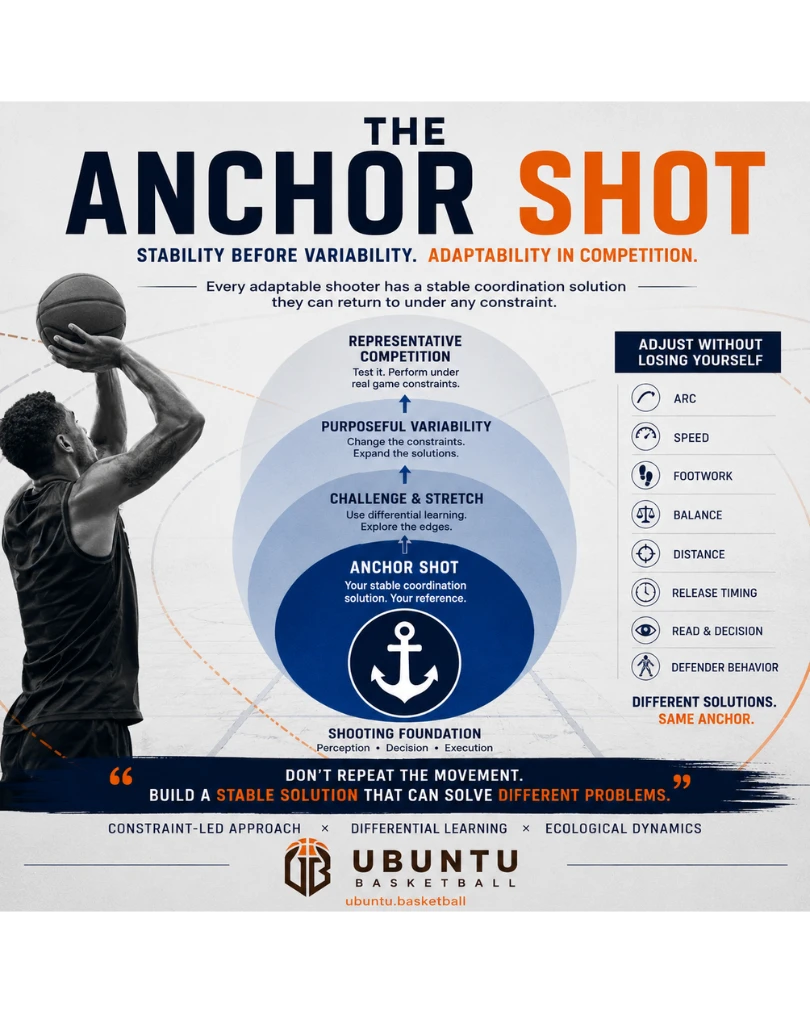
Introducing the Anchor Shot
At Ubuntu Basketball, I have started thinking about shooting through a slightly different lens.
I call it the Anchor Shot.
The Anchor Shot is not the perfect shot.
It is not one universal shooting technique.
It is not a biomechanical checklist.
Instead, it is:
The stable coordination solution an individual athlete repeatedly self-organizes toward under relatively low informational demands.
Every elite shooter appears to possess one.
Not because every game shot looks identical.
But because every adjustment begins somewhere.
Why this matters
Imagine asking a player to become more variable before they possess anything stable.
Every repetition looks different.
Every release changes.
Every rhythm changes.
Every foot placement changes.
The question becomes:
What exactly is the player adapting?
Without a dependable reference point, variability often becomes inconsistency.
The Anchor Shot provides that reference.
Stability is not rigidity
This is where ecological dynamics is frequently misunderstood.
Human movement is naturally variable.
However, humans also develop stable coordination tendencies—often described as attractors—that help them remain resistant to perturbations while still allowing adaptation. These attractors emerge through experience and evolve as practice constraints change.
The objective is therefore not to eliminate stability.
The objective is to create functional stability.
An Anchor Shot is simply one such functional attractor.
Think about Kobe Bryant
Kobe Bryant did not spend thousands of hours practising because every game shot would look identical.
Quite the opposite.
His career was defined by impossible fadeaways.
Wrong-foot finishes.
Off-balance pull-ups.
Late-clock improvisation.
Yet beneath every adaptation existed remarkable consistency in rhythm, intent, timing and coordination.
The countless repetitions did not imprison his movement.
They gave him the freedom to manipulate it.
One anchor.
Endless solutions.
The paradox of game-like shooting
Recently I read an excellent article by Pascal Meurs discussing what truly makes a shot "game-like."
He tells the story of Chip Engelland's famous workouts with Steve Kerr.
Instead of shooting hundreds of jumpers, Kerr would sit on the bench, wait, then suddenly hear "GO!", sprint onto the court, receive one pass, shoot once, and return to waiting.
Only seven shots were taken during an entire workout.
Yet those seven shots likely resembled Kerr's competitive reality far more than hundreds of uninterrupted repetitions.
Pascal's insight is powerful.
Representative practice is not simply about copying the movement.
It is about recreating the information, timing, uncertainty and emotional demands surrounding the movement.
Ubuntu Basketball's perspective
Where I believe Ubuntu Basketball extends this discussion is through one additional layer.
Representative learning environments are incredibly valuable.
But the athlete still requires something to organize around.
The Anchor Shot provides that.
Game-like constraints challenge it.
Differential Learning stretches it.
Competition validates it.
Variability has a purpose
Rob Gray frequently reminds us that the purpose of variability within CLA and Differential Learning is not to create random movement.
It is to encourage exploration, self-organization and more adaptable movement solutions under changing constraints. He also notes that how much variability a learner can benefit from depends on their current skill level and tolerance for challenge.
In Ubuntu Basketball, variability therefore becomes purposeful.
We might manipulate:
- Footwork
- Balance
- Arc
- Release height
- Release timing
- Catch angle
- Distance
- Tempo
- Defender behaviour
- Visual information
- Fatigue
- Decision complexity
The intention is never to destroy the Anchor Shot.
The intention is to expand its adaptability.
From mechanics to decisions
An Anchor Shot should never become a mechanical prison.
Basketball is not played in laboratories.
Players continuously reorganize their movements around defenders, teammates, fatigue, time pressure and available space.
Every shot represents a solution to a unique problem.
Therefore, at Ubuntu Basketball we don't simply ask:
"Can you repeat your shot?"
Instead we ask:
"Can you preserve your shooting identity while solving a completely different problem?"
That is adaptability.
The Ubuntu Basketball progression
Rather than moving from repetition directly into random practice, I prefer thinking about shooting development as a progression.
Phase 1 – Discover your Anchor Shot
Allow the athlete to explore until a reliable coordination solution naturally emerges.
Phase 2 – Stabilise it
Develop consistency in rhythm, timing, intent and ball flight without forcing identical repetitions.
Phase 3 – Challenge it
Introduce Differential Learning through purposeful movement variability.
Phase 4 – Represent it
Design representative environments that recreate the informational and emotional demands of competition rather than merely copying movements.
Phase 5 – Validate it
Measure whether the athlete maintains effective perception, decision-making and shooting performance under increasingly complex constraints.
Final thoughts
The future of shooting development is not about choosing between biomechanics and ecological dynamics.
Nor is it about choosing between repetition and variability.
The best shooters in the world appear to possess both stability and adaptability.
At Ubuntu Basketball, I believe those qualities begin with one simple idea.
Build an Anchor Shot. Challenge it with purposeful variability. Test it in representative competition.
Because ultimately, the goal of player development is not to repeat the same shot.
It is to solve different shooting problems without losing yourself as a shooter.
References
- Chow, J. Y., Davids, K., Button, C., Shuttleworth, R., Renshaw, I., & Araújo, D. (2006). Nonlinear pedagogy: A constraints-led framework for understanding emergence of game play and movement skills.
- Davids, K., Araújo, D., Vilar, L., Renshaw, I., & Pinder, R. (2013). An ecological dynamics approach to skill acquisition.
- Gray, R. (2021). How We Learn to Move. Discussion of attractors, self-organization, exploration, and practice variability.
- Meurs, P. (2026). The Paradox of Game-Like Shots. Reflections on representative shooting practice and the Steve Kerr example.
- Transforming Basketball. Ecological dynamics, self-organization, and representative learning in basketball.